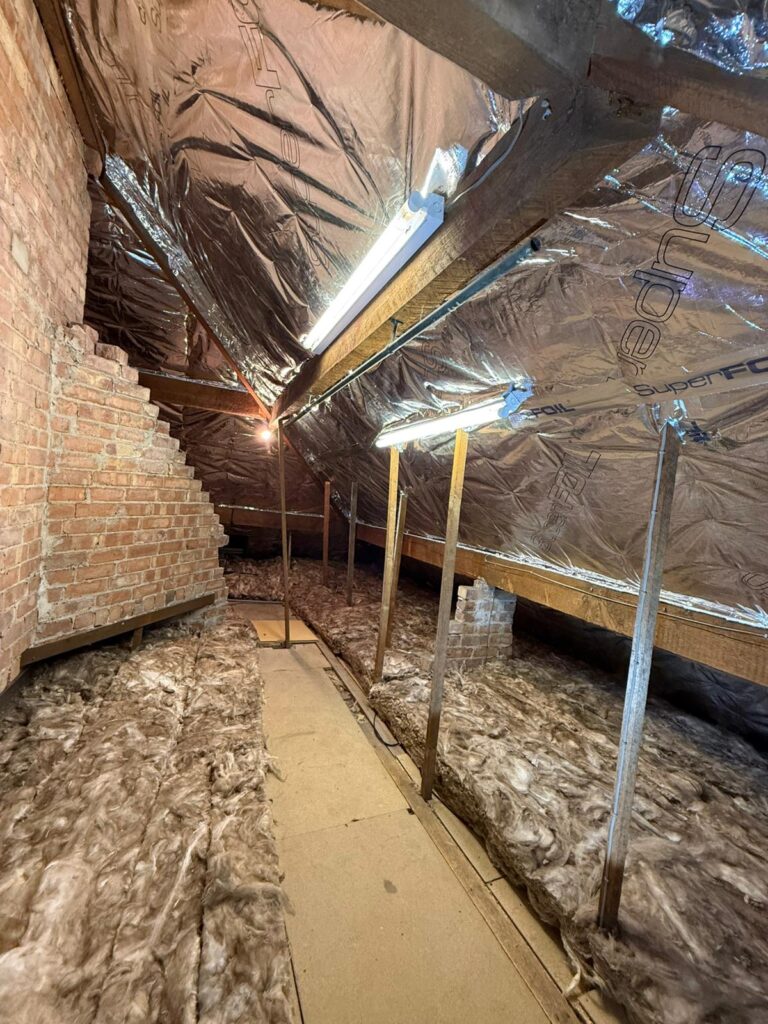
Insulating a Garden Room in Warrington: Getting It Warm Enough to Use All Year
A garden room is meant to be the room you escape to. Too often it’s the room you avoid from October to March, because the walls are thin timber, the roof is a single layer of OSB and felt, and a fan heater running flat out barely takes the chill off.
The good news is that most garden rooms can be fixed. The building is small, the structure is simple and there’s usually easy access to the inside of the frame.
Why garden rooms get so cold
Most garden buildings are lightweight timber frames. They have very little thermal mass, so they warm quickly and lose heat just as fast. Typical weak points are:
- an uninsulated or barely insulated roof — heat rises, so this is the biggest loss
- thin wall panels with no insulation between the studs
- a suspended timber floor with cold air moving underneath
- gaps around windows, doors and where the walls meet the base
Condensation is the other common complaint. Warm, moist air from people, kettles and heaters hits a cold timber surface and turns to water, which leads to damp smells, mould on the corners and swelling around the door.
Why depth matters in a timber building
In a house loft you can lay 270mm of insulation and be done. In a garden room every millimetre of insulation you add inside is a millimetre of room you lose, and the studs are often only 50–75mm deep.
That’s where multi foil insulation earns its place. A multi foil is a thin, flexible blanket of reflective foil layers and wadding. It works by trapping air between the layers and reflecting radiant heat back into the room in winter — and reflecting summer heat back out, which matters in a glazed garden office that bakes in July.
Because it’s thin and lightweight, it fits within the frame or straight across the studs without eating into the room, and it has a built-in vapour control layer, which deals with the condensation problem at the same time.
Roof, walls, then floor
If budget means doing it in stages, start with the roof. It loses the most heat and it’s usually the easiest part to get at. Walls come next, then the floor — a cold floor is the thing people notice most once the walls are done, because it’s suddenly the only cold surface left.
Whatever goes in, the finish matters. Taped joins, sealed edges and a continuous layer with no gaps are what make the difference between a room that holds heat and one that just feels slightly less cold.
Is it worth it?
For a room you actually want to use, yes. A properly insulated garden room heats up quickly on a small heater and stays comfortable, rather than needing heat pouring in constantly to stand still. It also protects the building — timber that stays dry and above dew point lasts far longer.
Common questions
Can you insulate a garden room that’s already finished inside? Often, yes. Depending on the build, we can work from inside behind new lining or from the roof. We’ll tell you what’s practical at the survey.
Does multi foil work for conservatories too? It’s commonly used for conservatory roof conversions and other places where space is tight. We’ll recommend the right system for the building rather than forcing one product into every job.
Do you cover my area? We’re based in Warrington and work across Widnes, Runcorn, St Helens, Newton-le-Willows, Golborne, Leigh, Culcheth, Lymm, Frodsham, Northwich and Greater Manchester.
Free garden room insulation survey
Tell us what you’ve got and how you want to use it, and we’ll recommend the simplest way to make it warm. Free survey, no-obligation quote, over 30 years’ experience and all work guaranteed.
Call 073 5919 5156 or get a quotation today.