
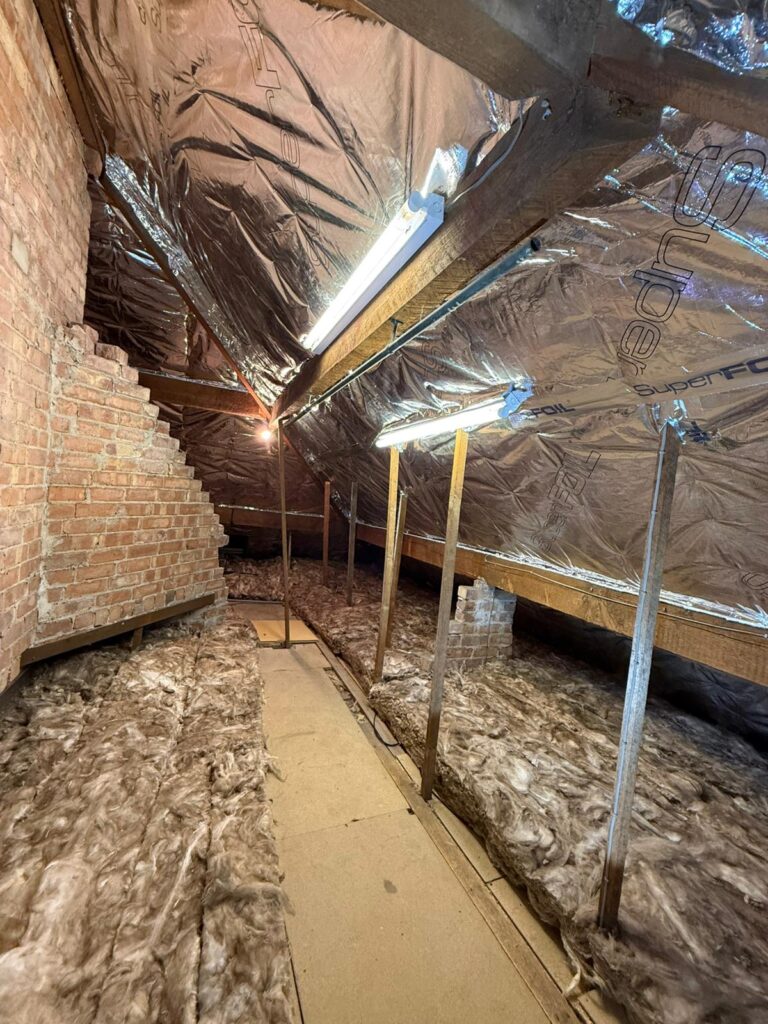
Multi Foil Insulation for Warrington Loft Conversions and Room-in-Roof
Converted lofts are the coldest rooms in a lot of Warrington houses. They bake in July and they’re freezing in January, because the sloping ceiling is often the thinnest part of the whole building envelope — sometimes nothing more than plasterboard fixed straight to the rafters.
The obvious fix is to pack the rafters with mineral wool or rigid board. The obvious problem is that you don’t have the depth to do it, and every millimetre you take off the room is headroom you can’t get back. That’s the gap multi foil insulation is designed to fill.
How multi foil works
Multi foil is built up from multiple reflective foil layers separated by wadding or foam. It works in two ways at once: the wadding slows conducted heat in the way any insulation does, and the reflective foil layers push radiant heat back where it came from — keeping warmth in during winter and reflecting solar gain out in summer.
Because the reflective element does a lot of the work, you get meaningful thermal performance from a layer that is thin and flexible rather than thick and rigid. Most products also include built-in vapour control, which matters enormously in a warm roof build-up.
Where it makes most sense
- Room-in-roof conversions where headroom is already tight and every 50mm counts.
- Pitched roofs and dormers in older Warrington properties, where rafter depth was never intended to accommodate modern insulation.
- Garden rooms and home offices, where a slim build-up keeps the internal space usable.
- Conservatory roofs that make the room unusable at both ends of the year.
- Awkward voids — dwarf walls, eaves cupboards, sloping sections behind stud walls — where getting rigid board in cleanly is difficult.
Installation is where the performance is won or lost
Multi foil is more sensitive to workmanship than almost any other insulation. Get it wrong and it underperforms badly. Three things matter more than anything else:
- The air gap. Reflective layers need a cavity to reflect across. Squash the foil flat against the plasterboard and you’ve thrown away the mechanism you paid for.
- Taped, continuous joints. Every lap and every penetration needs sealing properly, or you’ve built a vapour control layer with holes in it.
- Ventilation above. The roof still needs to breathe. Sealing the ventilation path is how you turn a cold room into a damp room.
This is genuinely a job worth having done by people who fit it regularly rather than occasionally.
Frequently asked questions
Is multi foil as good as thick mineral wool? Where you have unlimited depth, a deep conventional build-up is hard to beat on raw numbers. Where you don’t, multi foil gives you far better performance per millimetre — which is the comparison that actually matters in a converted loft.
Can I combine it with other insulation? Yes, and often that’s the best answer — a hybrid build-up using multi foil plus a thin rigid layer where the depth allows.
How disruptive is it? More than a straightforward loft insulation top-up, because it’s fitted behind the finished surface. We’ll be clear at survey stage about what’s involved for your specific room.
Will it help in summer too? That’s one of its real strengths. Reflecting radiant heat back out makes a noticeable difference to a south-facing loft room in July.
Free survey for multi foil insulation in Warrington
H&J Energy Solutions install modern insulation systems across Warrington, Lymm, Stockton Heath, Appleton, Grappenhall, Culcheth, Widnes, Runcorn and Greater Manchester. Free survey, no-obligation quote, work and materials guaranteed, and over 30 years in the trade.
Call 073 5919 5156 or get a quotation today.