
Getting Your Warrington Home Ready for Winter: An Insulation Checklist
The best time to sort out insulation is a warm week in late summer, when the loft is dry and comfortable to work in, contractors have availability, and you’re not making decisions in a panic because the first frost has arrived and the house won’t warm up.
Here’s a checklist you can work through yourself in an hour, and what to do about anything it turns up.
In the loft
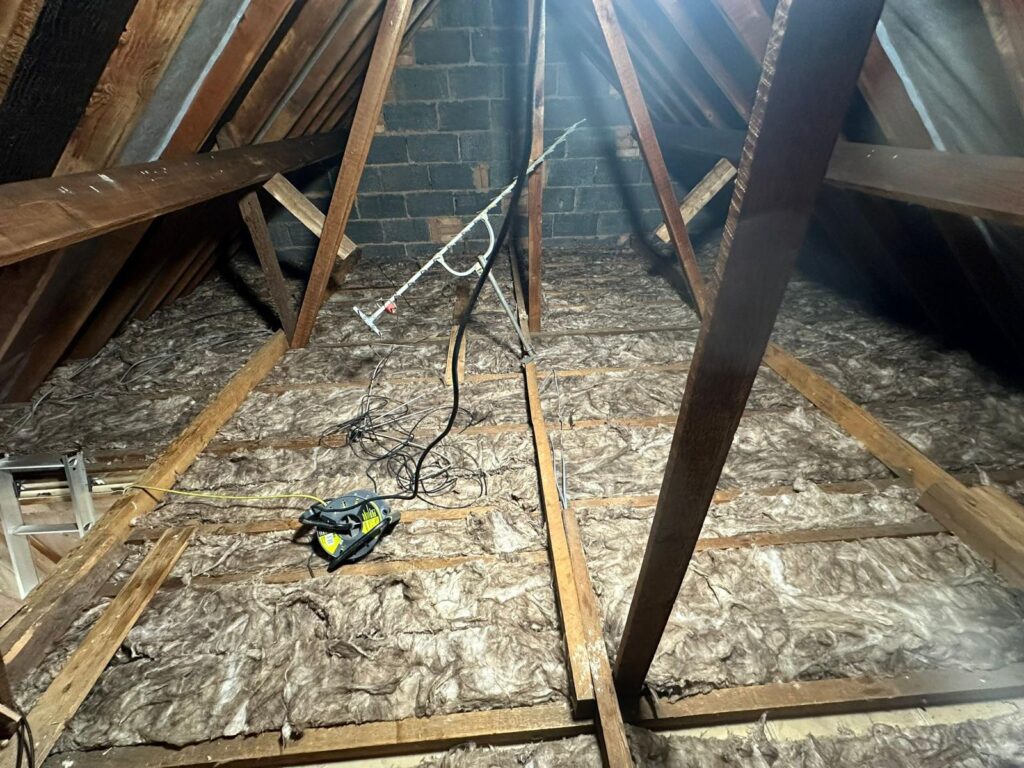
- Measure the insulation depth. Push a ruler down to the ceiling board. Under about 270mm and you’re due a top-up. If you can see the tops of the joists, you’re well short.
- Check it’s cross-laid. One layer between joists, a second across them. If it only runs one way, the timbers are conducting heat straight through.
- Look at the eaves. Air should be able to move in at the edges. Insulation stuffed tight into the eaves blocks that and causes condensation.
- Check the hatch. Insulated and with a seal, or it’s a hole in your ceiling.
- Look for spray foam. Anything sprayed onto the underside of the roof needs specialist attention rather than more insulation on top.
- Check for daylight, staining or damp timber — signs of a roof issue to fix before insulating.
Around the house
- Cold spots on external walls. Put a hand flat on an internal face of an external wall on a cold morning and compare it with an internal partition wall. A marked difference points to an empty or failed cavity.
- Recurring damp patches that get worse after driving rain — a penetrating damp issue on an exposed elevation.
- Draughts. Letterbox, keyholes, unused chimneys, gaps at skirtings, and around pipework where it passes through walls.
- Loft conversion rooms. If the converted bedroom is markedly colder than the rest of the house, the sloping ceilings are the weak point.
Outside
- Gutters and downpipes — clear and running properly. A leaking downpipe will soak a wall all winter and no insulation or coating will beat it.
- Pointing and render — cracked or blown sections let water into the masonry.
- Airbricks — clear, not blocked by soil, plants or a decking build-up.
What to do with the results
Work through them in order of impact. The loft first, since it’s the biggest loss and the cheapest fix. Then the walls — cavity wall insulation where there’s a suitable cavity, or a breathable ProPerla coating where the walls are solid or badly exposed. Converted lofts and dormers next, usually with multi foil. Draughts anytime — they’re cheap and quick.
And if the checklist turned up spray foam, start there. Removal comes before any other loft work.
Frequently asked questions
Is it too late to do this in autumn? Not at all — loft and cavity work is quick and we work through winter. But lead times lengthen as the weather turns, so earlier is easier.
I’m not confident going into the loft. Then don’t. Our survey is free and we’ll go up and do the whole checklist for you, with no obligation to buy anything.
How much of this can I do myself? Draught-proofing and clearing gutters, comfortably. Loft insulation is doable but easy to get wrong around eaves, hatches and pipework — and the mistakes cause condensation. Cavity and wall work needs proper equipment.
Book a free pre-winter survey
H&J Energy Solutions cover Warrington, Great Sankey, Penketh, Stockton Heath, Lymm, Culcheth, Birchwood, Widnes, Runcorn, St Helens, Newton-le-Willows and the wider North West. Over 30 years’ experience, free surveys, flexible hours, and all work and materials guaranteed.
Call 073 5919 5156 or get a quotation today.